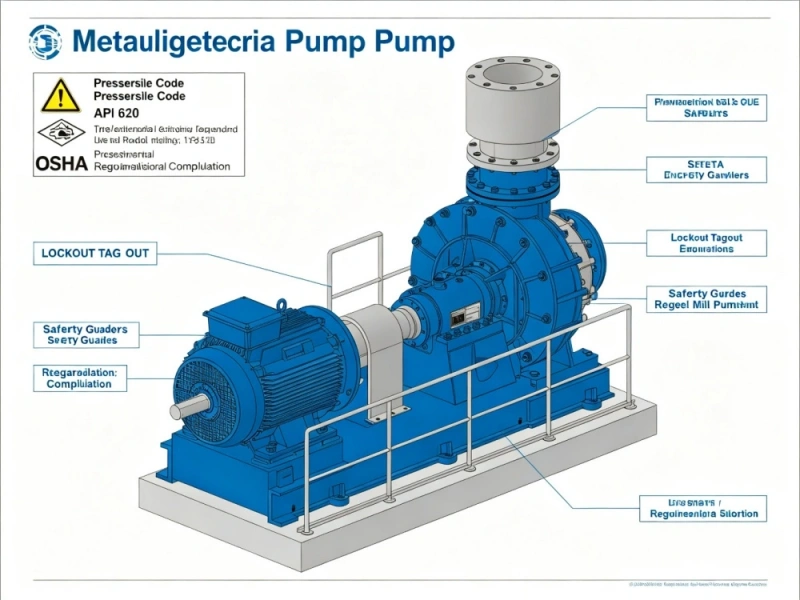
Metallurgical pumps handle some of the most hazardous fluids in industry: toxic cyanide (gold extraction), highly toxic mercury (amalgamation), carcinogenic chromic acid/Cr6+ (plating/refining), corrosive acids (sulfuric, hydrochloric, nitric, hydrofluoric), caustic soda (alumina Bayer process), high-temperature molten salts, and abrasive slurries under high pressure. Pump safety and regulatory compliance are critical to protect workers, prevent environmental releases, and meet legal requirements.
Hazard Identification
Metallurgical pump hazards include: toxicity (acute lethal - cyanide LD50 ~1 mg/kg, mercury neurotoxic, HF systemic toxicity; chronic - Cr6+ carcinogenic IARC Group 1, arsenic, nickel compounds; reproductive/developmental - mercury, lead), corrosion (chemical burns - acids/alkalis, tissue destruction - HF/concentrated H2SO4, material degradation - pitting/SCC/uniform corrosion), pressure (high pressure >10 bar - rupture/projectile, vacuum - collapse, water hammer - pressure spike), temperature (high temp >100C - thermal burns, low temp - embrittlement/freezing, thermal shock), abrasion (high-velocity solids - wear/casing thinning/rupture, particle injection injury), noise (>85 dBA - hearing loss), rotating equipment (coupling/shaft - entanglement/amputation, guard required), electrical (motor/VFD - shock/arc flash/fire), ergonomic (heavy components - lifting injury), environmental (spill/release - soil/water/air contamination, regulatory fines, reputational damage).
Risk Assessment Methods
Related Pump Solutions
Based on your application requirements, consider these pump options:
- HAZOP (Hazard and Operability Study) - Systematic team-based method using guide words (NO, MORE, LESS, REVERSE, OTHER THAN) to identify deviations from design intent. Recommended for new/modified pump systems handling hazardous fluids. Multidisciplinary team (process, mechanical, electrical, operations, maintenance, safety).
- LOPA (Layer of Protection Analysis) - Semi-quantitative method assessing adequacy of independent protection layers (IPLs). Determines if Safety Instrumented Function (SIF) is needed and its SIL level (SIL 1-4). SIL 1 PFD 0.1-0.01, SIL 2 0.01-0.001, SIL 3 0.001-0.0001.
- FMEA (Failure Modes and Effects Analysis) - Component-by-component analysis (impeller, casing, shaft, bearing, seal, coupling, motor) of failure modes, causes, effects, detection. Useful for mechanical integrity program.
- Bow-Tie Analysis - Visual method showing causes (left), top event (center), consequences (right), and barriers (preventive left, mitigating right). Useful for training and risk communication.
- Risk Matrix - Likelihood x Consequence matrix to prioritize risks. Consequence: safety (fatality/injury/first aid), environmental (major/minor/none), financial, regulatory. Likelihood: frequent/probable/occasional/remote/improbable. High/extreme risks require immediate mitigation.
Hierarchy of Controls
Apply controls in priority order: Elimination (remove hazard - phase out mercury, replace cyanide with thiosulfate/halide where feasible, eliminate HF if alternative). Substitution (replace with less hazardous - trivalent Cr passivation instead of hexavalent, non-cyanide zinc plating, lower concentration acid, lower temperature).
Engineering controls (isolate/contain - zero-leakage seals, secondary containment, ventilation, blast shields, pressure relief, SIS, remote operation, enclosed pump rooms).
Administrative controls (procedures/training - SOPs, LOTO, confined space, hot work, MOC, inspection/testing, emergency response, training, permits). PPE (last line - chemical-resistant gloves/face shield/apron/boots, respirators for toxic fumes/gases, hearing protection, safety glasses, hard hat). PPE alone is NOT sufficient for high-hazard fluids (cyanide, mercury, HF, Cr6+).
Zero-Leakage Pump and Seal Selection
For toxic/carcinogenic/corrosive fluids (cyanide, mercury, Cr6+, HF, concentrated acid, caustic, heavy metal wastewater), use zero-leakage configurations:
- Magnetic drive (sealless) - True zero leakage, no shaft seal, no seal maintenance. PREFERRED for clean hazardous fluids (<1% solids). Containment shell compatible with fluid (Alloy C-276, Hastelloy, titanium, PTFE-lined).
- Double mechanical seal with Plan 53A/B/C - Zero leakage, barrier fluid between two seals (barrier pressure > product pressure). Leak detection via barrier level/pressure monitoring. For hazardous/corrosive fluids including slurries.
- Welded metal bellows seal - For high-temperature (>150C) hazardous fluids where elastomers would degrade. No elastomers, all-metal bellows.
- Vertical cantilever sump pump - For hazardous slurry sumps. No submerged bearing or seal (cantilever design, bearing above liquid). Eliminates submerged seal failure point.
- AVOID packing (gland packing leaks by design 10-60 drops/min - unacceptable for hazardous fluids). AVOID single mechanical seal (can leak catastrophically on failure - no containment - not for hazardous/toxic).
For hazardous slurry, use double mechanical seal Plan 53 + Plan 32 (barrier + external flush for abrasives). Verify seal material: faces SiC/SiC for corrosive/abrasive, elastomers EPDM for acid/alkaline or FFKM/Kalrez for universal/hazardous/high temp, springs/hardware Alloy C-276 for corrosive.
Secondary Containment and Leak Detection
For all pumps handling hazardous fluids, install secondary containment (bund/dike/liner) capable of holding 110% of largest pump/piping volume (or per local regulation). Containment should be impermeable (HDPE liner, concrete with epoxy coating, stainless steel), sloped to collection point, with leak detection (liquid level sensor, pH sensor, specific fluid sensor for cyanide/HF/mercury).
For double mechanical seals, monitor barrier fluid level/pressure (alarm on drop indicates seal failure).
For magnetic drive, monitor pump performance and containment shell (external leak detection, performance changes).
Install gas/vapor detectors in enclosed pump areas (HCN for cyanide, Hg vapor for mercury, NOx/Cl2 for acids, HF, SO2) with alarms and ventilation interlocks. Install flow meters on suction/discharge to detect abnormal flow (leak, clog). All leak detection should alarm in control room and local (horn/strobe).
Overpressure Protection
Ensure pump casing and piping designed for maximum allowable working pressure (MAWP) per ASME BPVC Section VIII or API 670/674/675/676, including margin for pressure spikes (water hammer, startup). Install pressure relief valve (PRV) or rupture disc on discharge, especially for positive displacement pumps (which can generate infinite pressure if dead-headed).
PRV discharge routes to safe location (suction tank, neutralization, flare - NOT atmosphere for toxic fluids).
Consider thermal relief for trapped liquid between valves (thermal expansion can rupture piping/pump).
Install pressure transmitters with high-high alarm/trip (SIF) to shut down pump on overpressure. Design suction piping to prevent cavitation (adequate NPSHa, large diameter, minimal fittings, no air pockets). Consider water hammer protection (slow-opening valves, soft startup VFD, surge tanks, air chambers) for large/high-pressure systems.
Mechanical Integrity (OSHA PSM 1910.119(j), API Standards)
Implement mechanical integrity (MI) program for hazardous fluid pumps per OSHA PSM and API standards:
- Written procedures for inspection, testing, maintenance, repair.
- Training for maintenance personnel (initial and refresher).
- Inspection/testing based on risk (RBI API 580/581) and manufacturer recommendations.
- NDT methods: UT casing thickness (annually for high-risk, detect corrosion/erosion thinning), MT/PT shaft (crack detection during overhaul), RT castings (initial), vibration analysis (monthly/quarterly, detect bearing/impeller problems), performance testing (quarterly/annually, detect wear/efficiency drop), oil analysis (quarterly, detect bearing wear/contamination), seal flush monitoring (continuous, flow/pressure/filter).
- Quality assurance for repairs (qualified procedures/WPS, qualified welders, post-weld heat treatment, hydrostatic test after repair).
- Defect acceptance criteria (API 510/570, ASME, manufacturer).
- Maintain equipment records (inspection reports, repair history, NDT results, failure history, MOC).
- Schedule based on risk (high-risk - frequent, low-risk - less frequent). Predictive maintenance (condition monitoring) preferred over time-based.
Management of Change (MOC) and PSSR
Under OSHA 29 CFR 1910.119(l), the MOC process: request, technical review (multidisciplinary - process, mechanical, electrical, operations, maintenance, safety, environmental), hazard assessment (HAZOP/What-If for significant changes), risk assessment, update documentation (P&IDs, procedures, training, MI program), training for affected personnel, PSSR before startup (for significant changes), authorization, documentation.
Temporary changes also require MOC with time limit and return-to-normal. MOC prevents unintended consequences (e.g., changing seal type without evaluating leakage, changing material without verifying corrosion, increasing pressure without verifying MAWP).
Pre-Startup Safety Review (PSSR) per OSHA PSM (1910.119(f)(4)): Before startup of new or significantly modified pump handling hazardous fluids, conduct PSSR: verify construction/equipment per design/specification, verify safety/operating/maintenance/emergency procedures in place and current, verify training complete, verify PHA/HAZOP recommendations resolved or managed, verify MOC complete, verify emergency response equipment in place (eyewash/shower, spill kit, PPE, antidotes). PSSR must be documented and signed by authorized personnel before startup.
Emergency Response Plans
For each hazardous fluid pump system, develop site-specific emergency response plan (ERP) per OSHA PSM (1910.119(n)), EPA RMP, local regulations:
- Emergency contacts (internal, local fire/rescue, hospital, poison control, regulatory agencies - OSHA, EPA, local).
- Spill response (containment - secondary containment, booms, dikes; neutralization - acid with soda ash, caustic with weak acid, cyanide with NaOCl/H2O2; cleanup - absorbents, vacuum; disposal - hazardous waste).
- Leak response (isolate - ESD valve, shut down pump; contain - secondary containment; ventilate - if toxic gas/vapor; evacuate - if lethal concentration; notify - emergency response, regulatory agencies).
- Medical emergency (first aid - decontamination, eyewash/shower; antidotes - cyanide kit amyl nitrite/sodium nitrite/sodium thiosulfate, HF calcium gluconate gel/injection, mercury spill kit; transport to hospital with decontamination capability).
- Evacuation routes and assembly points, headcount procedures.
- Emergency equipment locations (eyewash/shower within 10 seconds, spill kits, neutralizers, respirators, PPE, fire extinguishers, antidote kits, communication devices).
- Training and drills (initial, annual refresher, tabletop exercises quarterly, full-scale drills annually).
- Decontamination procedures (personnel, equipment, site).
- Waste disposal (hazardous waste characterization, manifest, licensed transporter/disposer).
- Coordinate with local emergency responders (pre-incident planning, site visits, hazardous material inventory sharing).
Training and Written Procedures
Per OSHA PSM (1910.119(g)/(f)), provide training for operators and maintenance personnel:
- Operator training: pump operating procedures (startup, shutdown, normal, emergency), hazard awareness (toxicity, corrosion, pressure, temperature), monitoring (vibration, temp, pressure, flow, seal flush, leak detection), emergency response (spill, leak, medical, evacuation), PPE use, permit systems (LOTO, confined space, hot work).
- Maintenance training: pump maintenance procedures (disassembly, inspection, repair, assembly, alignment, seal installation), mechanical integrity (inspection, NDT, testing), safety procedures (LOTO, confined space, hazardous energy control, PPE), hazard awareness, emergency response.
- Written procedures: SOPs for each pump system (startup, shutdown, normal, emergency), maintenance procedures, inspection/testing procedures, safety procedures (LOTO, confined space, hot work, MOC), emergency response procedures. Procedures must be site-specific, current (updated via MOC), accessible to personnel, reviewed annually.
- Training must be documented (records, quizzes, on-the-job verification). Initial training before assignment, refresher annually or as needed.
Regulatory Compliance
Identify all applicable regulations and comply with all requirements:
- OSHA PSM (29 CFR 1910.119) - Applies if facility handles listed HHC at or above threshold (HF 1000 lb, HCN 1000 lb, formaldehyde 15000 lb, chlorine 1500 lb, ammonia 10000 lb). 14 elements: employee participation, PSI, PHA, operating procedures, training, contractors, PSSR, mechanical integrity, hot work permits, MOC, incident investigation, emergency planning, compliance audits (every 3 years), trade secrets.
- EPA RMP (40 CFR Part 68) - Similar to PSM but focused on off-site consequence analysis and emergency response.
- EU Seveso III Directive (2012/18/EU) - Applies to dangerous substances above threshold quantities, requires major accident prevention policy, safety report, emergency plans.
- International Cyanide Management Code (ICMC) - Voluntary but widely required for gold mining, covers cyanide production, transport, use, disposal.
- OSHA substance-specific standards - Cr6+ (29 CFR 1910.1026), lead (1910.1025), arsenic (1910.1018), mercury (1910.1000), formaldehyde (1910.1048).
- EPA - CWA (discharge permits), CAA (emission permits), CERCLA (release notification >RQ), EPCRA (emergency planning, Tier II inventory, TRI).
- Local/national regulations - China Safety Production Law, Environmental Protection Law, GB standards (GB 50160, GBZ 2.1), EU directives.
- ISO standards - 45001 (OH&S), 14001 (environmental), 31000 (risk), IEC 61508/61511 (functional safety).
Maintain all documentation (PSI, PHA, procedures, training records, inspection/NDT reports, MOC records, incident reports, audit reports, emergency drills) for regulatory inspections. Designate responsible persons (PSM coordinator, safety officer, environmental officer, MI lead). Track safety KPIs (incident rates, near-miss reporting, audit findings, corrective action closure, training completion, MI inspection completion, drill participation).
Specific Guidance for High-Hazard Fluids
- Cyanide (gold/silver extraction): Zero leakage (magnetic drive or double seal - NO packing). Secondary containment (impermeable, cyanide-specific leak detection). pH monitoring (maintain >10.5 to prevent HCN gas, alarm if <10). HCN gas detectors (enclosed areas, alarm + ventilation interlock). Cyanide antidote kit (amyl nitrite, sodium nitrite, sodium thiosulfate - accessible, trained personnel). Emergency eyewash/shower (within 10 seconds). Spill response (NaOCl or H2O2 detoxification, controlled). Compliance (International Cyanide Management Code, local regulations).
- Mercury (amalgamation): Strongly recommend phase-out (banned/restricted in many jurisdictions, safer alternatives exist). If used: zero leakage (magnetic drive or double seal - NO packing). Secondary containment (impermeable, mercury-specific spill kit - sulfur powder, mercury vacuum). Mercury vapor detectors (enclosed areas, OSHA PEL 0.01 mg/m3, alarm). Medical surveillance (exposed workers - urine mercury, neurological exams). Spill response (mercury-specific kit - no broom/ordinary vacuum, use sulfur powder + specialized mercury vacuum, ventilate, professional cleanup). Compliance (OSHA, EPA, local mercury regulations, Minamata Convention).
- Chromic acid/Cr6+ (plating/refining): Zero leakage (magnetic drive or double seal - NO packing). Secondary containment (impermeable, Cr6+ spill kit). Cr6+ air monitoring (OSHA PEL 0.005 mg/m3, initial and periodic, medical surveillance if exposed). Respiratory protection (if airborne - N95 or better, fit testing, medical clearance). Spill response (Cr6+ specific - reduce to Cr3+ with reducing agent, contain, dispose as hazardous waste). Training (Cr6+ hazards - carcinogenic, respiratory, skin ulceration, spill response). Compliance (OSHA 29 CFR 1910.1026, EPA, local regulations).
- Hydrofluoric acid (HF, aluminum/uranium): Zero leakage (magnetic drive or double seal - NO packing). Secondary containment (impermeable, HF-resistant materials - HDPE, PVDF, PTFE; NOT glass). HF-specific emergency equipment (calcium gluconate gel - skin exposure, calcium gluconate injection - severe exposure, trained medical personnel; water spray for vapor). HF detectors (enclosed areas, OSHA PEL 3 ppm, IDLH 30 ppm, alarm + ventilation). Spill response (HF-specific - calcium carbonate/calcium hydroxide neutralization, NOT water directly on large amounts (exothermic, can spread), professional cleanup). Medical surveillance (exposed workers - urine fluoride, bone density, dental). Training (HF hazards - systemic toxicity, hypocalcemia, delayed symptoms, first aid, calcium gluconate administration). Compliance (OSHA, EPA, local regulations).
- Concentrated sulfuric acid (smelting/acid plants): Zero leakage (double seal or magnetic drive - NO packing for >70% H2SO4). Secondary containment (acid-resistant - concrete with epoxy, HDPE, FRP). Temperature monitoring (exothermic with water - prevent water ingress, dilution cooling). Spill response (acid-specific - soda ash/limestone neutralization, NOT water directly on concentrated acid (exothermic, spattering), absorb with inert material). PPE (face shield, acid-resistant gloves/boots/apron - butyl rubber, neoprene; NOT latex). Training (acid hazards - severe burns, dehydration, exothermic dilution, spill response).
- Caustic soda (Bayer process): Zero leakage (double seal or magnetic drive - NO packing for >20% NaOH at >50C). Secondary containment (caustic-resistant - concrete with epoxy, HDPE, FRP; caustic is slippery). Temperature monitoring (concentrated NaOH 50% at 100-150C - thermal burns, SCC in stainless). Material selection (nickel 200/Alloy C-276 for concentrated/high-temp, AVOID 316L for >80C concentrated caustic - SCC). Spill response (caustic-specific - dilute with water, neutralize with weak acid (acetic, citric), absorb with inert material; caustic is slippery - prevent falls). PPE (face shield, caustic-resistant gloves/boots/apron - butyl rubber, neoprene, PVC; NOT latex). Training (caustic hazards - severe burns, slippery, SCC, exothermic with water, spill response).
- High-pressure slurry (tailings pipeline 50-200 bar): Pressure design (casing/piping for MAWP + margin, PRV/rupture disc). Pipeline integrity (UT thickness inspection, RBI, leak detection along pipeline). Emergency shutdown (ESD valves at pipeline ends, remote operation). Secondary containment (pump area, potential rupture points - containment, leak detection). Training (high-pressure hazards - rupture, projectile, injection injury, emergency response). PPE (face shield, hard hat, safety glasses - for high-pressure areas).
Summary
Metallurgical pump safety and regulatory compliance is a comprehensive, lifecycle program integrated into all aspects of pump design, procurement, installation, operation, maintenance, and modification. Built on hazard identification and risk assessment (HAZOP, LOPA, FMEA), implemented through engineering controls (zero-leakage seals, secondary containment, SIS, pressure relief), administrative controls (procedures, training, MOC, MI, inspection), and PPE (last line).
Regulatory compliance (OSHA PSM, EPA RMP, EU Seveso III, ICMC, substance-specific standards) is a legal requirement, and emergency response (spill/leak/medical/evacuation) must be planned and drilled.
The goal is zero incidents, zero environmental releases, and full regulatory compliance - protecting workers, the community, the environment, and the business.
Product Solutions
- Stainless Steel Centrifugal Pump for metallurgical process water
- Multistage Pump for high-pressure metallurgical service
- Vertical Slurry Pump for metallurgical slurry handling
View all Slurry & Wastewater Pumps → | View all Special Industrial Pumps →
Useful Engineering Tools