Cooling water and circulation pumps are critical infrastructure in metallurgical plants, serving blast furnace cooling, continuous casting water systems, rolling mill cooling, furnace cooling jackets, heat exchanger circulation, quench water, and HVAC systems. These pumps handle large volumes at moderate heads with high reliability requirements for 24/7 operation.
Cooling Water Systems in Metallurgical Plants
Metallurgical plants require extensive cooling water systems to remove heat from processes and equipment. Major system types include:
- Open recirculating cooling systems - Most common. Water circulates through heat exchangers and equipment, then cooled in cooling towers by evaporative cooling. Water is treated with chemicals including corrosion inhibitors, scale inhibitors, and biocides. Typical for blast furnace cooling, continuous casting, rolling mills, and HVAC. Blowdown is required to control dissolved solids.
- Closed loop cooling systems - Water circulates in a sealed loop, cooled by plate and frame heat exchangers transferring heat to a secondary cooling loop, or by air coolers. No evaporation, minimal water treatment, high water quality often deionized or softened. Used for critical equipment including furnace cooling jackets, induction furnace cooling, power electronics, and high-value heat exchangers.
- Once-through cooling systems - Water taken from river, lake, or sea, passed through equipment once, then discharged. High water consumption, limited by environmental regulations. Used where water is abundant and discharge temperature is regulated.
- Evaporative cooling with cooling towers - Water cooled by evaporation in cooling towers including counterflow, crossflow, forced draft, and natural draft designs. Most efficient for large heat loads. Requires makeup water of 2-3% of circulation for evaporation plus blowdown and drift. Water treatment is critical for scale, corrosion, biological growth, and Legionella control.
- Quench water systems - Rapid cooling of hot products including steel quenching and metal heat treatment. High flow, moderate head, often with filtration to remove scale and particles. Water temperature rises significantly, requiring cooling tower or heat exchanger to remove heat.
Pump Types for Cooling Water and Circulation
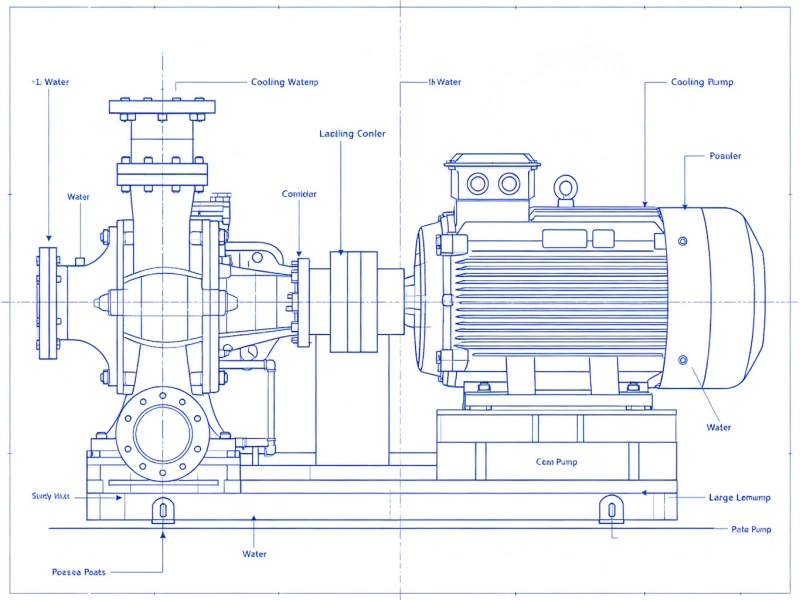
- Horizontal split case double suction centrifugal pump - Most common for large cooling water systems. Double suction impeller provides low NPSHr and balanced axial thrust. Split casing allows easy maintenance without removing piping. Flow range 100-10000 cubic meters per hour, head 20-200 meters. High efficiency of 85-92%. Used for cooling tower circulation, heat exchanger circulation, and plant service water.
- Vertical turbine mixed flow pump - Vertical shaft with impeller submerged in wet pit or can. Large flow of 500-20000 cubic meters per hour, low to medium head of 5-100 meters. Used for cooling water intake from river, lake, or sea, cooling tower sump pumps, and large circulation systems. Space-saving vertical installation. Requires proper submergence to prevent vortexing.
- End suction centrifugal pump - Simple and cost-effective design. Flow 10-500 cubic meters per hour, head 10-150 meters. Used for smaller cooling systems, HVAC, auxiliary cooling, makeup water, and chemical dosing. Back pull-out design allows maintenance without disconnecting piping.
- Multistage centrifugal pump - Multiple impellers in series for high head. Flow 10-300 cubic meters per hour, head 100-500 meters. Used for high-pressure cooling, boiler feed, long-distance circulation, and high-rise building cooling.
- Self-priming centrifugal pump - Can prime itself without external priming or foot valve. Flow 20-300 cubic meters per hour, head 10-80 meters. Used for cooling water transfer from underground tanks and sumps, portable cooling systems, and emergency cooling. Some designs offer solids handling capability.
- Axial flow propeller pump - Very large flow of 1000-50000 cubic meters per hour, very low head of 2-20 meters. Used for massive cooling water circulation in power plants and large steel plants, and flood control. High efficiency at specific operating point but poor off-design performance.
Technical Specifications
- Flow rate: 10-20000 cubic meters per hour, with typical cooling water applications at 100-5000 cubic meters per hour. Determined by heat load calculation and system design requirements.
- Head: 5-500 meters, with typical cooling water at 20-150 meters. Includes static lift, friction loss in piping and fittings, heat exchanger pressure drop, cooling tower pressure, and velocity head.
- NPSH Net Positive Suction Head: Available NPSHa must exceed required NPSHr by a safety margin of 0.5-3 meters. Critical for preventing cavitation. Cooling tower pumps calculate NPSHa as tower water level minus suction piping loss minus vapor pressure. Vertical turbine pumps calculate NPSHa as submergence plus atmospheric pressure.
- Efficiency: 70-92%, with large split case pumps at 85-92%, end suction at 70-85%, and vertical turbine at 80-90%. Energy cost is significant for large pumps operating 24/7. IE3 or IE4 premium efficiency motors are recommended.
- Motor power: 5-5000 kW, with typical applications at 15-500 kW. Determined by flow, head, efficiency, and specific gravity.
- Speed: 1450 or 2900 RPM for 50 Hz, 1750 or 3500 RPM for 60 Hz. Large low-head pumps often use 1450 RPM for larger impeller and higher efficiency. VFD is used for variable flow control.
- Materials of construction: Cast iron casing for clean treated water is most common and cost-effective. Bronze or duplex stainless for seawater or corrosive water. 316L stainless for high chloride or deionized water. Bronze impeller for seawater. Duplex 2205 for severe corrosion. Mechanical seal uses SiC on SiC faces with EPDM elastomer for water service.
- Operating temperature: 0-80 degrees Celsius, with typical cooling water at 20-45 degrees. Cooling water return temperature is 35-45 degrees, supply is 25-32 degrees. High-temperature cooling such as quench water return up to 80-95 degrees requires special seals and bearings.
- Solids handling: Cooling water typically has less than 50 mg/L suspended solids when filtered. Raw water from river or lake may have 100-1000 mg/L, requiring screening, filtration, and open impeller or non-clog design. Seawater has biological fouling from mussels and barnacles, requiring chlorination or mechanical cleaning.
- Reliability and availability: 24/7 continuous operation. MTBF greater than 40000 hours or 5 years. Redundant configuration of N+1 or 2x100%. Critical cooling for blast furnace and continuous casting requires emergency power from diesel generator and backup pumps.
Selection Factors
- Water quality and treatment: Most critical factor. Open recirculating systems face scale from calcium carbonate and calcium sulfate, corrosion from oxygen, chloride, and sulfate, biological fouling from bacteria, algae, and Legionella, and suspended solids. Requires chemical treatment with corrosion and scale inhibitors, biocides, and dispersants, side stream filtration of 5-10%, and blowdown control. Closed loop systems have high water quality that is deionized or softened, minimal treatment, and corrosion inhibitors such as nitrite, molybdate, or organic. Seawater has high chloride causing pitting, crevice, and SCC corrosion, plus biological fouling, requiring bronze, duplex, or 2205 materials and chlorination or antifouling systems.
- System type and configuration: Open recirculating cooling tower systems use large split case or vertical turbine pumps with moderate head and high flow. Closed loop systems use end suction or inline pumps with lower flow and higher head due to heat exchanger pressure drop. Once-through systems use vertical turbine or axial flow pumps with very large flow and low head. Quench water systems use split case or end suction pumps with high flow, moderate head, and filtration. HVAC and chiller systems use end suction or inline pumps with variable flow and VFD.
- Redundancy and reliability: Critical cooling for blast furnace, continuous casting, and furnace cooling requires N+1 redundancy with one standby pump, or 2x100% with two pumps each at 100% capacity. Emergency power from diesel generator is essential for critical pumps. Automatic start and stop on pressure or flow signals. Quick-disconnect couplings for portable backup. Non-critical cooling such as HVAC and auxiliary equipment may use a single pump with spare parts on hand.
- Energy efficiency: Cooling water pumps are major energy consumers operating 24/7 with large motors. Select high-efficiency pumps with MEI greater than 0.7 and best efficiency point near the operating point. Use IE3 or IE4 premium efficiency motors. Install VFD for variable flow to reduce energy at part load, following affinity laws where power is proportional to flow cubed. Proper sizing avoids oversized pumps that waste energy through throttling. Parallel operation stages pumps on and off for variable load instead of throttling.
- NPSH and cavitation prevention: Calculate NPSHa accurately including tower water level, suction piping loss, and vapor pressure at maximum temperature. Ensure NPSHa exceeds NPSHr by 0.5-3 meters margin. For cooling tower pumps, locate the pump below the tower basin for positive suction head, minimize suction piping length and fittings, use large suction piping, and avoid high points that trap air. For vertical turbine pumps, ensure adequate submergence to prevent vortexing using vortex breakers, bell mouths, and proper spacing between multiple pumps. Cavitation causes gravel sound noise, vibration, impeller pitting, seal failure, and performance drop.
- Maintenance accessibility: Split case pumps provide easy access to impeller and seal without removing piping, preferred for large systems. Back pull-out end suction pumps allow removing the rotating assembly without disconnecting piping. Vertical turbine pumps require pulling the entire column, which is more maintenance intensive but space-saving. Consider lifting equipment such as overhead crane or monorail for large pumps. Maintain spare parts inventory including seals, bearings, impeller, and shaft sleeve.
- Control and monitoring: VFD provides flow control with energy saving, soft start, and water hammer reduction. Pressure and flow transmitters enable monitoring and control. Vibration and temperature sensors support condition monitoring for predictive maintenance. Seal leak detection is used for double seals monitoring barrier fluid level and pressure. Level sensors monitor tower basin and sump levels. Automatic pump sequencing provides lead and lag rotation for equal runtime. SCADA integration enables remote monitoring, alarming, and data logging.
- Water hammer protection: Large cooling water systems are susceptible to water hammer from sudden valve closure, pump trip, power failure, rapid pump startup, air pockets in piping, and check valve slam. Mitigation includes slow-opening and closing valves, VFD soft start and stop with ramp up and down, surge tanks, air chambers, pressure relief valves, slow-closing non-slam check valves, and proper valve operation procedures. Pump trip with power failure can cause reverse flow and water hammer, requiring check valves and consideration of flywheels or VFD with kinetic energy ride-through.
Engineering Applications
Blast furnace cooling system: Blast furnaces require extensive cooling to protect the refractory and shell from extreme heat of 1500-2000 degrees Celsius inside.
Cooling water systems include stave cooling with copper or steel staves having water channels in furnace walls, cooling plates with copper plates between staves, tuyere cooling with copper tuyeres having internal water cooling that is critical as tuyeres are exposed to 2000 degrees plus, hearth cooling with copper staves or spray cooling at furnace bottom, and closed loop cooling with high-purity water for stave and tuyere cooling using plate heat exchangers to a secondary loop.
Pumps are large split case or vertical turbine for primary circulation, with high reliability of 24/7 operation, N+1 redundancy, and emergency power. Closed loop systems use high water quality with 316L or duplex materials, moderate head of 30-80 meters, and high flow of 500-3000 cubic meters per hour.
Failure consequences are severe including tuyere burn-through, furnace damage, production loss, and safety hazard. Requires redundant pumps, emergency cooling with water spray and portable pumps, and continuous monitoring.
Continuous casting water systems: Continuous casting machines cool molten steel into slabs, billets, or blooms.
Water systems include primary cooling with mold cooling using copper mold with water channels at high flow that is critical, secondary cooling with spray cooling below the mold using water sprays on steel strand with controlled cooling rate for metallurgical structure, roller cooling for conveyor roller cooling, and machine cooling for hydraulic, electrical, and lubrication cooling.
Pumps for mold cooling require high reliability, closed loop, moderate flow and head, and 316L materials. Secondary cooling uses spray nozzles requiring filtered water of 50-100 micron, moderate pressure of 3-10 bar, and flow control per zone using VFD or control valves. General machine cooling uses open recirculating split case pumps.
All systems are critical as casting interruption causes quality issues and equipment damage. Redundancy is required with emergency water supply from gravity tank or diesel pump.
Rolling mill cooling and descaling: Rolling mills shape hot or cold steel into sheets, bars, and rods.
Water systems include descaling with high-pressure water of 100-200 bar to remove scale from hot steel using separate high-pressure multistage or plunger pumps that are not typical cooling water pumps, roll cooling with water sprays on work rolls and backup rolls to control temperature and surface quality, table cooling for roller table cooling, mill motor cooling for large electric motors using air and water heat exchangers, and hydraulic and lubrication cooling with oil coolers.
Pumps for roll cooling require moderate flow, filtered water, spray nozzles, and VFD for flow control. General cooling uses split case pumps in open recirculating systems. Descaling uses a separate high-pressure system with multistage centrifugal or plunger pumps and accumulators for instantaneous demand.
Water quality is important as scale particles can clog nozzles and damage roll surface.
Furnace cooling systems: Various metallurgical furnaces require cooling. Electric arc furnace EAF uses roof and water-cooled panels, electrode arms, and bus tubes. Ladle furnace LF uses roof cooling. Induction furnace uses copper coil cooling that is critical with closed loop and high-purity water.
Annealing furnaces use radiant tube cooling and muffle cooling. Sintering machines use pallet cooling and exhaust gas cooling. Pumps for induction furnace cooling are critical with closed loop, high-purity deionized water, 316L or better materials, low conductivity less than 5 microsiemens per cm, N+1 redundancy, and emergency power.
EAF cooling uses large flow with open or closed loop and moderate head. All furnace cooling is critical as failure can cause furnace damage, molten metal breakthrough, and safety hazard.
Heat exchanger circulation: Heat exchangers including shell and tube, plate and frame, and air-cooled types transfer heat between process fluids and cooling water. Pumps circulate cooling water through heat exchangers.
Considerations include heat exchanger pressure drop that is often significant at 1-5 bar and affects pump head, fouling from biological growth, scale, and particles that reduces heat transfer and increases pressure drop, flow distribution for multiple heat exchangers in parallel requiring balancing valves and flow meters, and temperature control using 3-way mixing valve or VFD to control cooling water flow based on process temperature.
Pumps are split case or end suction with moderate head including heat exchanger pressure drop, VFD for temperature control, and materials based on water quality.
Quench water systems: Quenching rapidly cools hot metal including steel quenching for hardness, aluminum quenching, and heat treatment.
Water systems include quench tank with large volume of water where hot metal is immersed or sprayed, circulation pump with high flow to maintain temperature and agitation, heat exchanger or cooling tower to remove heat from quench water, filtration to remove scale, metal particles, and quenching oil residue, and water treatment for corrosion, scale, and biological control as quench water can be hot at 60-90 degrees and aggressive.
Pumps have high flow of 200-2000 cubic meters per hour, moderate head of 20-60 meters, materials for hot water with mechanical seal rated for high temperature and bearing cooling, filtration with strainers and self-cleaning filters, and are often redundant as quenching interruption causes quality issues.
HVAC and chiller systems: Plant buildings, control rooms, electrical rooms, and data centers require HVAC cooling.
Water systems include chilled water loop from chiller to air handlers and fan coil units in closed loop with typical 7 degrees supply and 12 degrees return, condenser water loop from chiller condenser to cooling tower in open loop with 30 degrees supply and 35 degrees return, makeup water, and water treatment.
Pumps for chilled water are end suction or inline with variable flow using VFD, closed loop, and moderate head. Condenser water pumps are split case in open loop with larger flow and cooling tower. All HVAC pumps require VFD for energy efficiency at variable load, differential pressure control, and staging.
Materials are cast iron for treated water and bronze for seawater-cooled condensers.
Common Problems and Solutions
- Cavitation: Causes include insufficient NPSH, high water temperature with high vapor pressure, clogged suction strainer, air leakage in suction, and impeller damage. Symptoms include gravel or rumbling noise, vibration, impeller pitting visible on inspection, performance drop in flow and head, and seal failure. Solutions include increasing NPSHa by lowering pump, increasing suction pipe size, reducing suction fittings, and raising tower water level; reducing NPSHr with larger pump, lower speed, or double suction; installing suction stabilizer; cleaning strainers; fixing air leaks; reducing water temperature; and replacing damaged impeller.
- Mechanical seal leakage: Causes include seal face wear from abrasive particles or dry running, seal face damage from cavitation or water hammer, elastomer degradation from high temperature or chemical attack, incorrect seal installation, shaft sleeve wear, and seal flush failure from blocked filter or low pressure. Symptoms include visible leakage at seal, product loss, environmental contamination, and bearing contamination from water in oil. Solutions include using correct seal type and material with SiC on SiC faces for water and EPDM elastomer, maintaining seal flush with clean filters and correct pressure, avoiding dry running with interlock on minimum flow, installing double seal with barrier fluid for critical service, regular seal inspection and replacement, and shaft sleeve replacement.
- Bearing failure: Causes include lubrication failure from over or under greasing, incorrect grease, or grease contamination with water ingress; misalignment from pump-motor coupling misalignment or pipe strain; excessive vibration from cavitation, imbalance, or resonance; overheating from high ambient, cooling failure, or excessive load; and electrical issues from motor bearing current due to VFD requiring shaft grounding. Symptoms include high bearing temperature, noise such as grinding or rumbling, vibration, and bearing seizure causing motor overload or trip. Solutions include proper lubrication with correct grease, correct quantity, and regular interval; precision alignment using laser alignment within tolerances; vibration monitoring for predictive maintenance; bearing isolation for VFD using shaft grounding ring or insulated bearing; proper installation without pipe strain and with foundation rigidity; and bearing replacement at first sign of wear.
- Impeller corrosion and erosion: Causes include corrosion from low pH, high chloride, dissolved oxygen, or galvanic action; erosion from high velocity, abrasive particles, or cavitation; corrosion-erosion synergy that is worse than either alone; and selective phase corrosion including cast iron graphitic corrosion and duplex sigma phase. Symptoms include impeller weight loss, pitting, vanes thinning, performance drop in flow and head, vibration from imbalance due to material loss, and pieces breaking off causing damage to casing or seal. Solutions include correct material selection with bronze for seawater, 316L for high chloride, duplex 2205 for severe, and cast iron for clean treated water; water treatment with corrosion inhibitors, pH control, and oxygen scavengers; reducing velocity with larger pump or lower speed; filtering particles with strainers and filters; cathodic protection for seawater using zinc anodes; and regular impeller inspection and replacement.
- Excessive vibration: Causes include misalignment of coupling or pump-motor, imbalance from impeller fouling or corrosion or bent shaft, cavitation, resonance from operating at critical speed or foundation and piping resonance, bearing wear, loose components such as foundation bolts or casing bolts, and hydraulic pulsation from off-design operation, recirculation, or vane pass frequency. Symptoms include high vibration readings with overall greater than 4.5 mm per second RMS alarm and greater than 7.1 trip, noise, bearing and seal failure, pipe cracks, and foundation loosening. Solutions include precision alignment, dynamic balance of impeller, resolving cavitation, avoiding operating at critical speed by changing speed or pump, tightening loose components, operating near BEP, vibration analysis using spectrum to identify frequency and cause, and structural modifications to stiffen foundation or piping or add mass.
- Motor overload and trip: Causes include pump oversized operating at high flow and high power, impeller too large with diameter too large, high specific gravity fluid, bearing failure with high friction, seal failure with high friction, misalignment with high load, voltage imbalance, single phasing, and VFD malfunction. Symptoms include high motor current above nameplate FLA, motor overheating, thermal overload trip, and breaker trip. Solutions include trimming impeller to reduce diameter to match duty point, throttling discharge valve as temporary measure that wastes energy, reducing speed with VFD, correct motor sizing, resolving mechanical issues with bearings, alignment, and seals, checking electrical supply for voltage and phase balance, and VFD parameter check.
- Water hammer: Causes include sudden valve closure from fast-acting valves or solenoid valves, pump trip from power failure or emergency stop, rapid pump startup, air pockets in piping, and check valve slam from rapid closure on flow reversal. Symptoms include loud banging noise, pipe movement and vibration, pressure spikes that can exceed pipe MAWP, pipe and joint failure, pump damage to impeller, seal, and casing, and gauge damage. Solutions include slow-opening and closing valves with actuator time delay, VFD soft start and stop with ramp up and down, surge tanks and accumulators, air chambers as pressure vessels, pressure relief valves, non-slam check valves with slow closing tilt disc, proper valve operation procedures to train operators, air vents to remove air pockets, and flywheel for pump trip to slow deceleration.
- Biological fouling and scaling: Causes include open recirculating systems providing ideal environment for biological growth from bacteria, algae, fungi, and Legionella; scale formation from calcium carbonate, calcium sulfate, and silica due to high dissolved solids and temperature; and suspended solids deposition. Symptoms include reduced heat transfer with cooling tower approach increase and process temperature rise, increased pressure drop in heat exchangers and piping, reduced flow from clogged strainers and nozzles, corrosion from under-deposit corrosion and microbiologically influenced corrosion MIC, unpleasant odor, and Legionella risk as health hazard. Solutions include water treatment program with corrosion and scale inhibitors, biocides both oxidizing and non-oxidizing, and dispersants; side stream filtration of 5-10% flow at 20-50 micron; blowdown control based on conductivity maintaining cycles of concentration at 3-6; regular cleaning with mechanical pigging and rodding or chemical acid cleaning and biocide shock; cooling tower maintenance including clean basin, drift eliminators, and fill; and Legionella testing and control per local regulations.
Practical Guidance
Open recirculating systems use cooling towers where water is cooled by evaporation using latent heat. Water is exposed to air, so it picks up oxygen, dust, and biological contaminants, requiring chemical treatment with corrosion and scale inhibitors and biocides, plus blowdown to control dissolved solids.
These systems typically use large horizontal split case double-suction pumps or vertical turbine pumps because they handle high flow rates of 100-10000 cubic meters per hour at moderate heads of 20-150 meters, and the split case design allows easy maintenance without removing piping.
Closed loop systems circulate water in a sealed loop, cooled by plate heat exchangers transferring heat to a secondary open loop, or by air coolers. Since there is no evaporation or air contact, water quality remains high, often deionized or softened, requiring minimal treatment with just corrosion inhibitors such as nitrite or molybdate.
Closed loop systems typically use end suction centrifugal pumps or inline pumps because flow rates are lower at 10-500 cubic meters per hour and heads are often higher due to heat exchanger pressure drops of 1-5 bar.
The key differences are that open systems have higher water treatment costs and corrosion risk but lower capital cost for large heat loads, while closed systems have higher water quality, lower corrosion, but higher capital cost from heat exchangers and are used for critical equipment.
Pump selection follows the system requirements with large split case or vertical turbine for open systems and end suction or inline for closed loops.
Cooling water flow rate is calculated from the heat load equation where Q in kW equals m in kg per second times cp in kJ per kgK times deltaT in K, where Q is the heat to be removed, m is mass flow rate, cp is specific heat of water at 4.18 kJ per kgK, and deltaT is the allowable temperature rise across the heat exchanger, typically 5-10 degrees for cooling water.
Rearranged gives m equals Q divided by cp times deltaT, then convert to volumetric flow with flow in cubic meters per hour equals m in kg per second times 3600 divided by 1000 for water density.
For example, a 500 kW heat load with 8 degree deltaT gives m equals 500 divided by 4.18 times 8 equals 14.95 kg per second equals 53.8 cubic meters per hour.
Pump head is the sum of static head as elevation difference between suction and discharge liquid levels, often zero for closed loops; friction loss in piping calculated using Darcy-Weisbach or Hazen-Williams including pipe friction and fittings using equivalent length method; heat exchanger pressure drop obtained from manufacturer, typically 0.5-3 bar for shell and tube and 0.3-1 bar for plate and frame; cooling tower pressure if open system including nozzle pressure and distribution height; and velocity head, usually small and included in friction calculations.
Add a safety margin of 10-20% for fouling, aging, and calculation uncertainty. For example, static 0 meters plus piping friction 15 meters plus heat exchanger 25 meters at 2.5 bar plus margin 8 meters equals 48 meters total head.
Always verify with system curve analysis and ensure the pump operates near its best efficiency point BEP for energy efficiency and reliability.
Critical cooling water systems including blast furnace stave and tuyere cooling, continuous casting mold cooling, induction furnace coil cooling, and EAF roof cooling require high redundancy because pump failure can cause catastrophic equipment damage, production loss, and safety hazards such as molten metal breakthrough and furnace burn-through.
Recommended configurations include N+1 redundancy with one standby pump for N operating pumps, for example 3 pumps each at 50% capacity with 2 running plus 1 standby, or 2 pumps each at 100% capacity with 1 running plus 1 standby.
For the most critical systems such as blast furnace tuyere cooling and induction furnace, a 2x100% configuration with two pumps each capable of full load is preferred, with automatic start of standby on pressure or flow drop or running pump failure.
Emergency power supply from diesel generator or UPS is essential for critical pumps as power failure is a common cause of cooling loss. Automatic transfer switch ATS should start generator and transfer load within 10-30 seconds.
Gravity-fed emergency water supply from elevated tank with enough volume for safe shutdown, typically 15-30 minutes, provides additional protection.
Controls include automatic pump sequencing with lead and lag rotation for equal runtime, low pressure or flow start standby, high vibration or temperature trip, remote monitoring via SCADA, and alarms with local horn and strobe plus remote notification.
Maintenance includes weekly test of standby pump to start and verify flow and pressure, monthly test of emergency generator, quarterly test of automatic transfer, and annual full-load test. Non-critical cooling such as HVAC, auxiliary equipment, and general service water may use a single pump with spare parts on hand, or N+1 for larger systems.
The redundancy level should be determined by risk assessment considering consequence of failure times probability, equipment value, production loss cost, safety risk, and repair time.
Related Pump Solutions
Based on your application requirements, consider these pump options:
Procurement Recommendations
- Redundancy and reliability: Specify N+1 or 2x100% redundancy for critical cooling including blast furnace, continuous casting, and furnace cooling. Require MTBF greater than 40000 hours and proven references in metallurgical applications. Include emergency power interface with diesel generator and ATS. Specify automatic standby start on pressure or flow drop. Require 24/7 technical support and local spare parts availability.
- Energy efficiency: Require pump efficiency at BEP greater than 85% with large pumps greater than 88%, and MEI greater than 0.7. Specify IE3 or IE4 premium efficiency motors. Include VFD for variable flow systems for energy saving and soft start. Require pump curve showing operating point within 80-110% of BEP to avoid overloading, cavitation, and recirculation. Consider parallel pump staging for variable load for energy saving versus throttling. Calculate lifecycle cost LCC as energy cost over 10-20 years often exceeds purchase price by 5-10 times.
- Materials and construction: Specify materials based on actual water quality analysis from lab testing. Cast iron for clean treated water is most common and cost-effective. Bronze or duplex for seawater or high chloride. 316L for closed loop high-purity water. Duplex 2205 for severe corrosion. Require material certification with mill test reports per EN 10204 3.1. Specify mechanical seal with SiC on SiC faces, EPDM or Viton elastomer based on water, Plan 11 flush with internal recirculation for clean water, and Plan 32 with external flush for dirty water. Require bearing housing with lip seals plus labyrinth to prevent water ingress.
- Condition monitoring and controls: Include vibration sensors with accelerometers on bearing housings in X and Y axes, RTD temperature sensors for bearings, seal chamber, and motor windings, pressure and flow transmitters for suction, discharge, and seal flush, and seal leak detection for double seals monitoring barrier fluid level and pressure. Specify VFD with built-in protection for overcurrent, overvoltage, ground fault, and dry run. Require SCADA integration using Modbus, Profibus, or Ethernet IP for remote monitoring, alarming, and data logging. Include local control panel with HMI for start and stop, status, alarms, and trends.
- Maintenance and spare parts: Require split case or back pull-out design for easy maintenance without piping removal. Include lifting points, baseplate with grouting holes, and alignment tools. Specify spare parts package including 2 sets mechanical seals, 1 set bearings, 1 impeller, 1 shaft sleeve, 1 set gaskets and O-rings, and coupling element. Require maintenance manual with detailed procedures, torque values, and tolerances. Include commissioning and training with operator and maintenance training for 2-3 days on-site. Require 12-24 month warranty for parts and labor, with extended warranty option.
- Testing and certification: Require factory performance test per ISO 9906 Grade 2 or API 610 to verify flow, head, power, efficiency, and NPSHr. Require mechanical run test for vibration, temperature, and noise per API 610 or ISO 9906. Require hydrostatic test of casing at 1.5 times MAWP. Include NDT for critical castings using RT or UT per API 610 or customer specification. Require CE marking per PED 2014/68/EU or ASME U-stamp if required. Include ISO 9001 quality certification and ISO 14001 environmental certification.
- Water hammer and transient analysis: For large systems greater than 500 cubic meters per hour with long piping, require transient analysis or water hammer study by qualified engineer. Specify mitigation based on analysis including slow-acting valves with closure time greater than 5 times pipeline period, VFD soft start and stop with ramp of 10-30 seconds, surge tank or air chamber sized for max pressure, non-slam check valve with tilt disc and slow closing, and pressure relief valves. Require valve operation procedures in manual to avoid rapid closure.
Metallurgical Pump Wear & Cost
Metallurgical processes involve high temperatures, abrasive scale, and corrosive slag. Pumps operate in severe conditions.
Typical pump life by application:
- Scale pit pumps: 6-12 months (abrasive scale, high temperature)
- Cooling water pumps: 5-10 years (clean water, moderate temperature)
- FGD pumps: 2-4 years (corrosive slurry, high abrasion)
Budget for replacement parts: 10-20% of pump purchase price per year for severe-duty applications.
Product Solutions
Explore our range of industrial pumps for cooling water and circulation applications in metallurgical plants:
- Horizontal Split Case Pump - Double suction, split casing, high flow of 100-10000 cubic meters per hour, high efficiency of 85-92%, easy maintenance, ideal for cooling tower circulation, heat exchanger circulation, and plant service water in metallurgical plants.
- Vertical Turbine Pump - Vertical shaft, wet pit or can installation, large flow of 500-20000 cubic meters per hour, low to medium head, space-saving, ideal for cooling water intake from river, lake, or sea, cooling tower sump pumps, and large circulation systems.
- End Suction Centrifugal Pump - Simple, cost-effective, back pull-out design, flow 10-500 cubic meters per hour, head 10-150 meters, ideal for smaller cooling systems, HVAC and chiller, auxiliary cooling, makeup water, and chemical dosing in metallurgical plants.
- Self Priming Pump - Self-priming capability, no external priming or foot valve, flow 20-300 cubic meters per hour, head 10-80 meters, solids handling, ideal for cooling water transfer from underground tanks and sumps, portable cooling systems, and emergency cooling in metallurgical plants.
- Multistage Centrifugal Pump - Multiple impellers in series, high head of 100-500 meters, flow 10-300 cubic meters per hour, ideal for high-pressure cooling, boiler feed, long-distance circulation, and high-rise building cooling in metallurgical plants.
View all API Process Pumps → | View all Self Priming Pumps → | View all Special Industrial Pumps →
Related Industries
- Metallurgy - Blast furnace, continuous casting, rolling mills, furnaces, smelting, refining, and plating all require extensive cooling water systems.
- Power Generation - Power plants including coal, gas, nuclear, and renewable require massive cooling water systems for condenser cooling, cooling towers, and auxiliary cooling, with similar pump types and challenges.
- Chemical and Petrochemical - Chemical plants require cooling water for reactors, distillation, and heat exchangers, with similar system design, pump types, and water treatment challenges.
- Mining and Mineral Processing - Mining operations require cooling water for compressors, crushers, mills, and smelters, with similar pump applications and often raw water quality challenges.